
CLAUDE LAZAR
Claude Lazar, artiste peintre, vit et travaille entre New York et Paris
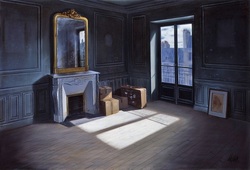
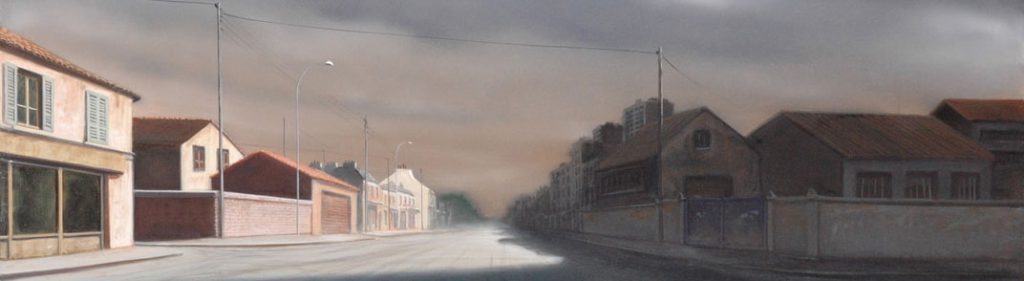
The actors are not there yet, but they are coming. The stage is set. The day is rising, the shadows are moving away. The titles evoke bits of dialogues, of flashing thoughts, of laughter, of innocent fragments of daily life. The only thing left to do is wait.
There are beds, armchairs, and space. Everything is ready to welcome them. They should be coming now. Shouldn’t they? The chairs look comfortable, the mattresses of good quality.
On second thought, I don’t know if Claude Lazar speaks of a « before » or an « after » state. Should one see in his work an imminent occupation, or traces of a recent passage? In any case, the dust particles remain in suspension, whirling around themselves.
We rarely see an artist take into consideration, to such an extent, emptiness and absence. It is even rarer when he does it with such persistency and such frankness. This void is so empty that he feels obliged to place a few pieces of furniture in it so as not to be accused of morbid exaggeration, hence making us think that it is a frightening world. Which, of course, it isn’t. The world is merely what it is, made up of a sumptuous, permanent, silent, and smooth barrenness.
The more solitary a man is, the more he can easily smile, like the battle of a sunbeam against the walls of a dark room, a window open to the emptiness of the sky, or the silhouette of a woman, so long as she will always be seen from behind. The more a man paints empty bedrooms, the fuller his life becomes. The more he grows up, the more the universe freezes, shrinks, and sometimes gives a pure jewel, a pure, genuine, and quite informal despair. At least we are sure of that. At least we are sure of the accuracy of the inner gaze. As sure as these rooms where the wooden floors don’t creak.
Philippe Djian
Les acteurs ne sont pas encore là, mais ils vont arriver. Les décors sont en place. Le jour se lève, les ombres s’éloignent ; Les titres évoquent des bribes de dialogues, des pensées fulgurantes, des rires, d’innocents lambeaux de quotidien. Il ne reste plus qu’à attendre.
Il y a des lits, des fauteuils, de l’espace. Tout est prêt pour les accueillir ; Maintenant, ils devraient arriver. Non, Les sièges semblent confortables, les matelas de bonne qualité.
Je ne sais pas si Claude Lazar parle d’avant ou d’après, à la réflexion. Si l’on doit voir dans son travail l’imminence de l’occupation ou la trace d’un passage. En tout cas, les particules de poussière demeurent en suspension, tourbillonnant sur elles-mêmes.
Il est rare qu’un artiste fasse à ce point état du vide, de l’absence. Encore plus rare qu’il le fasse avec une telle obstination et une telle franchise. Ce vide est tellement vide qu’il s’oblige à y placer quelques pièces de mobilier pour ne pas être accusé d’exagération morbide et par là donner à penser que ce monde est effrayant, ce qu’il n’est pas, bien sûr, le monde est simplement tel qu’il est, d’une aridité somptueuse, permanente, silencieuse et lisse.
Plus un homme est solitaire et plus il a le sourire facile comme le combat d’un rayon de soleil contre les parois d’une chambre obscure, une fenêtre ouverte sur le néant du ciel ou la silhouette d’une femme à condition qu’elle soit toujours de dos. Plus un homme peint de chambres vides et plus sa vie s’emplit. Plus il grandit et plus l’univers se fige, et rapetisse, donnant parfois un pur joyau, un pur désespoir authentique, sans chichis. Au moins sommes nous sûrs de ça. Au moins sommes nous sûrs de la justesse du regard intérieur. Comme du silence de ces pièces où les parquets ne grincent pas.
Philippe Djian